Computing at the speed of light.
Computing at the speed of light.
Aspheric is building a new class of optical computer — a slab of lithium niobate, programmed with light, designed to be reconfigured into the photonic circuit a workload needs.
We're a pre-seed company. We're assembling the team, reproducing the underlying science, and building the IP to take programmable photonic computing out of the laboratory.
Modern inference workloads now consume hundreds to thousands of watts per GPU. Data center power draw is growing faster than the grid can keep up. Every generation of silicon delivers smaller gains for greater cost — and the physics doesn't get easier from here.
The next leap won't come from packing more transistors onto a die. It will come from changing what does the computing.
Our approach
We compute with light.
Published research has shown that projecting patterns onto a photoconductive layer above a lithium niobate waveguide can program optical neural networks directly into the chip's refractive index. No etching. No fixed wiring. No discrete components.
The thesis: a single small chip that performs a high-dimensional matrix-vector multiply at a fraction of the power of conventional silicon, and can be reprogrammed milliseconds later for an entirely different computation. Aspheric's near-term work is to reproduce that result in our own hands and improve on it.
The ambition: an FPGA for photonics — a reprogrammable substrate for the optical circuits a workload needs.
Where we are
A pre-seed company. Doing the foundational work.
We're not selling products yet — we're building the foundations to.
01 / Team
Assembling expertise
We're bringing together leading researchers and engineers in thin-film lithium niobate, programmable photonics, and analog computing.
02 / Science
Reproducing the science
We are independently rebuilding the published academic results that this technology rests on, validating every layer of the stack in our own hands.
03 / IP
Building the IP
Working from those reproductions, we are identifying patentable improvements over the academic baseline and developing a defensible IP portfolio around the core architecture.
This is the unglamorous work that determines whether a deep-tech company has a real future. We're doing it deliberately and on the record.
What comes next
With seed funding, we move from science to engineering.
Software
Software Factory
Simulator, SDK, and an end-to-end SaaS development platform: design, compile, and deploy accelerated workloads — first in simulation, then on our hardware.
Hardware
Embedded photonic chips
Targeted at specific high-value applications — starting with domains where speed, latency, and power efficiency justify a new architecture.
Foundry
Partnerships at scale
Moving from in-house prototyping to scalable thin-film lithium niobate fabrication.
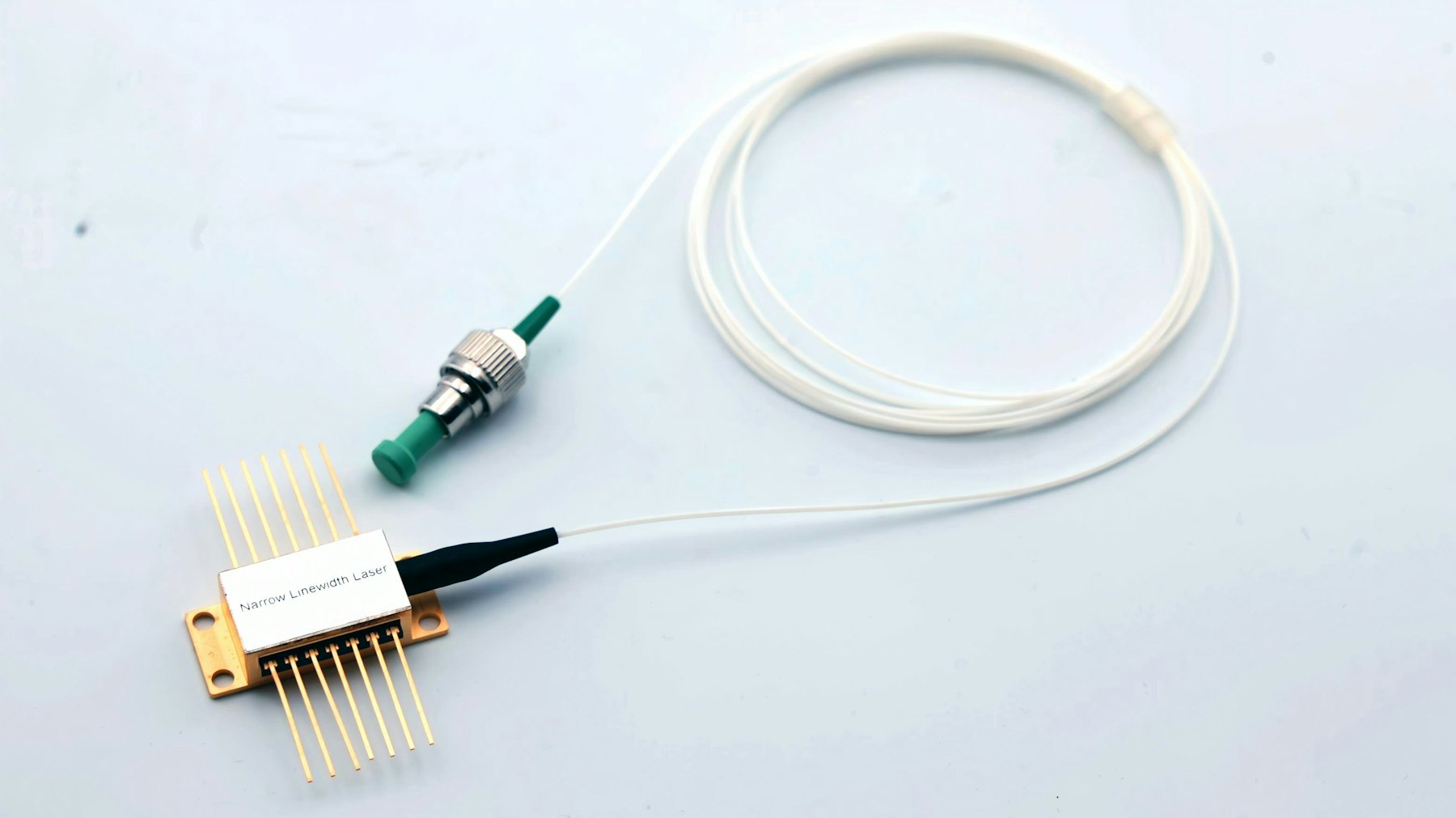
Fiber-coupled narrow-linewidth laser module — the class of component our chips are driven by.
The destination is a general-purpose programmable photonic computer. The path there runs through real customers solving real problems with focused, embedded versions of the technology.
Three shifts are converging to make programmable photonics commercially feasible.
Manufacturing
The fab has caught up
Thin-film lithium niobate, once a laboratory curiosity, is moving to high-volume foundry production.
Workloads
The math has caught up
The AI industry's move toward low-precision inference matches the natural operating range of analog optical computing.
Capital
The market has caught up
Federal research programs and strategic acquirers are actively funding photonic compute as the successor architecture to GPU-based inference.
We think the next decade of computing belongs to light. We're building the company that gets there first.
Company
Founded to commercialize a new generation of programmable photonic systems.
Our technical foundation builds on peer-reviewed research published in Nature Physics. Aspheric is independently reproducing those results and developing improvements over the academic baseline. Our work is grounded in close collaboration with experts across the photonics community.
We're a small team. We're hiring.
Get in touch
We're talking with researchers, engineers, prospective collaborators, and a select group of early investors.